Cortex AI Analítica
"Análisis de relevancia para la actualidad."
- Beck arrived at the radio station alone, lugging an acoustic guitar up the stairs.
As he sat down, I was playing Bob Dylan’s Last Thoughts on Woody Guthrie: a breathless spoken-word ramble that made him visibly twitch. “Can I do that?” Um, sure. He flipped a notebook to a densely scribbled page, I opened the mic and he went for it. The guitar stayed in its case.
“I had that from a young age,” he says today. “When I started to go to the record store with my parents, I would complain that all the songs sounded the same. I remember saying, ‘I wish there was an album where every song was totally different’.”
His dad, the Hollywood composer-arranger David Campbell, told him that would never work because “people want music that sounds like the thing they like”. Beck “thought that was boring”.
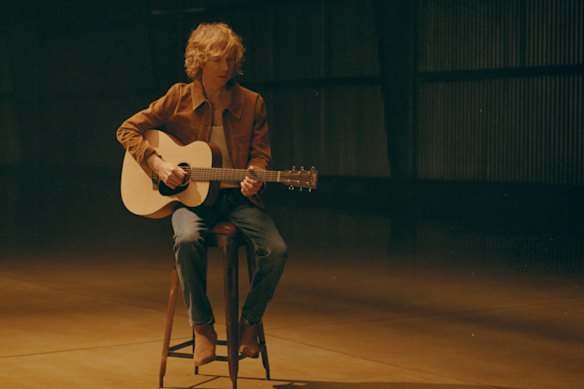
Beck during his folk-country tour in 2023.
“Maybe it’s distracted attention or something, but I think that was kind of an ethos of my generation, cultivating this deep vein of surprise and novelty and ‘What’s new and strange and unexpected?’ So that’s what I was trying to do.”
If it’s hard to be unexpected now, that’s partly Beck’s fault. His upstart identity in the ’90s alternative scene was based on ramming every available genre into what he once described as his “trash compactor”.
When he returns to Australia next month, it will be to perform with symphony orchestras: just another thing pop musicians often do now, but not often with this kind of range. “It’s almost like you earn it,” he says. “It was sort of surprising that as we went through my records, there were about 30 songs that had orchestras on them. So it is kind of its own body of work amongst all the records.”
It was his father he naturally worked with as arrangements escalated from Odelay to Sea Change. But David Campbell’s immense catalogue – Carole King to the Rolling Stones; The Rose to Wayne’s World – had been less influential than other aspects of a family steeped in art. “My grandfather [Al Hansen] started in the ’50s in New York, and John Cage was his professor, so he fell into performance art and experimental art and music. He ended up collaborating with a lot of people like Nam June Paik and Yoko Ono.”
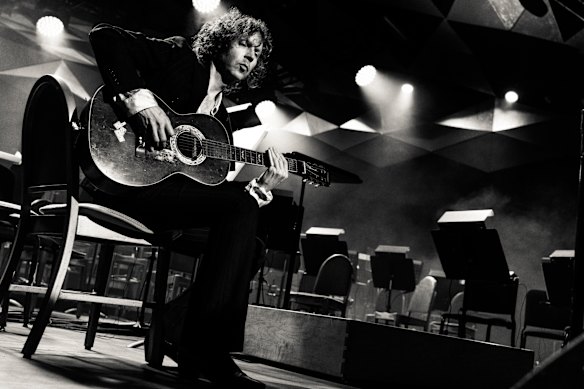
Beck performing with the Boston pops orchestra.Brent Goldman
That’s how Beck’s mother, Bibbe Hansen, wound up in movies by Jonas Mekas and Andy Warhol in the ’60s. “She was just a kid hanging out with her friends … and Warhol would feed her. My family were broke, and she was a teenager, so if she was hanging out with him, he always took her out to get a burger.”
The surreal image was just family lore by the time Beck was born on the other side of the continent. The outsider art ethos of Fluxus and the Factory was “not a conscious influence”, he says,“but I think there’s maybe an aesthetic that runs through.
“I spent time with my grandfather as a kid, but there was never much discussion of art or process. It was more something that he was doing in the way, say, your uncle was working on cars. You pick up some things by osmosis.”
Given his father’s hundreds of scores, it’s funny that one film he remembers absorbing was Rumble Fish, yes for Stewart Copeland’s wild score, but also for the familiarity of Francis Coppola’s gritty world of young Americans adrift. “My parents were so young,” he says. “So that dynamic of child and authority figure … No, it was more like, ‘We’re in this together, we’re all growing up together and figuring it out’.
“When I compare it to how my kids are growing up (Cosimo is 20, Tuesday 18), it’s extremely different. I think it was conducive to a certain exploration; being influenced by your environment. It was definitely a colourful environment but … I wouldn’t say it was safe. It wasn’t protected.”
The lack of guardrails was great for his creative mind but “by the time I came along, there wasn’t a lot you could do that would be transgressive musically,” he says. “I came after punk, and before that was hippies and psychedelia and all these things that upturned traditions. So the idea of mixing up genres or having wildly different sounding music was a kind of punk for me: something that was transgressive and confrontational and disruptive. I think it was always this idea of disrupting expectations … I liked that shape-shifting thing.”
TAKE 7: THE ANSWERS ACCORDING TO BECK
- Worst habit? Insomnia. Probably a byproduct of 30 years on the road. But some of the good ideas come at night.
- Greatest fear? I have a moderate case of acrophobia. Not really in nature, but more in context of a building. I guess I put my trust more in a mountain than something man-made. I’m not a fan of glass stairways.
- The line that stayed with you? ”These are the good old days.” I think I came up with it, but it might’ve just been something I heard. I guess it’s the inverse of “the best is still ahead”.
- Biggest regret? I wish I had spent less time on the road when I was young and more time making albums. I think there’s something special about that first five to 10 years … you’re connected to something wild and unself-conscious.
- Favourite book My current favourite is Stoner (by John Edward Williams). An unaffected, pure capturing of the human. I couldn’t speak for days after I finished it.
- The artwork/song you wish was yours? I got to play with the members of Nirvana right before Covid. Man, those songs are made of something different. They’re like riding down a mountain.
- If you could time travel, where would you choose to go? LA in the 1920s and ’30s. Right when the city was booming and transitioning from farmland and oil fields into a movie fantasy land.
It all gels with the solitary kid dragging his guitar into that radio station back in ’94, then thwarting expectations when the mic light went on. Even in his first rush, the idea of playing his hit du jour was already testing his boredom trigger. “I remember when I first came out with Loser, there was a kind of mould that was cast for me. And it was almost like the undertaker was showing me my coffin to step into, and I really bristled at it.
“They wanted to put me on the cover of Time magazine … and I was going to be the face of ‘Slacker’ or Generation X or something. We did everything we could, so I’d be taken off. I think they used Eddie Vedder instead, and I felt like I dodged a bullet,” he says. “Immediately after that, I started wearing three-piece suits and I cut my hair short and did everything the opposite.”
What’s weird in hindsight, he says, is how upset some people got. “I remember journalists telling me that mixing of genres … felt like insincerity, like I wasn’t committing to one idea. I was zooming around to all these different musical sound worlds. But to me, it just felt like the future.
“There won’t be any genres,” he predicted. “Indie rockers will be influenced by R&B as well as Krautrock and Britney Spears … it’s going to be all mixed up. There’s going to be no rules.”
Except perhaps for one: orchestras rock. “The orchestra means a lot to me,” Beck says. “It’s like the ultimate music machine. This thing has evolved over so many centuries and if we were to lose electronic technology tomorrow and everything got reduced to bare essentials, an orchestra could still exist.”
We live, he says, “in a push-button era of music. So to me, the ethos of an orchestra, 70 or 80 people all together playing as one, is a really beautiful human endeavour. It’s this sound that comes from such a deeply human place. It feels like it’s the old way, but it also feels like the last frontier.”
Beck performs at the Sydney Opera House with the SSO on May 7, 8 and 9 and the Palais Melbourne with Philharmonia Australia May 12 and 13.
The Booklist is a weekly newsletter for book lovers from Jason Steger. Get it delivered every Friday.