Cortex AI Analítica
"Análisis de relevancia para la actualidad."
- A day after passing over the far side of the moon, the crew of NASA’s Artemis II mission is now on the return leg of its journey, and the pace of activity has slowed.
The spacecraft carrying the astronauts, which they had named Integrity, left the sphere of lunar influence at 1:23pm on Tuesday (US Eastern Time).
That meant that the attraction of Earth’s gravity was stronger than the moon’s, accelerating them toward a splashdown in the Pacific Ocean on Friday (US Time).
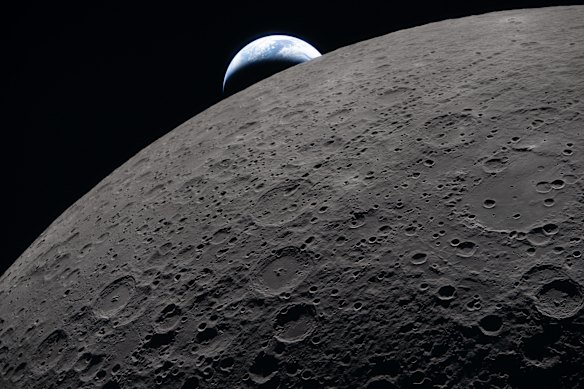
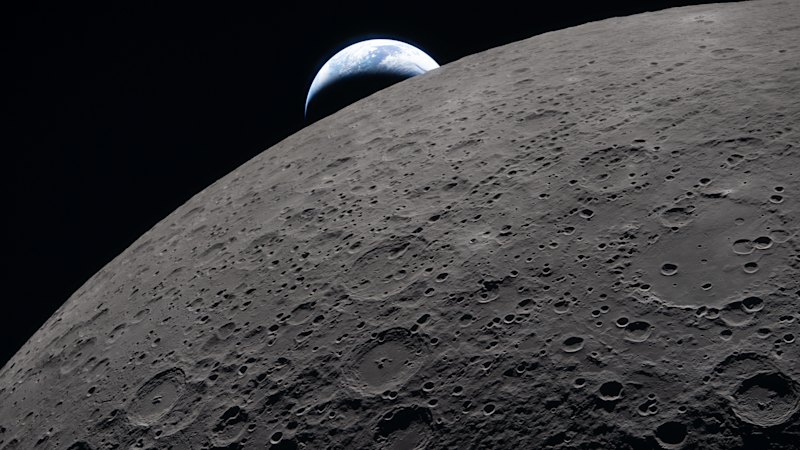
The Earth setting behind the moon. NASA/AP
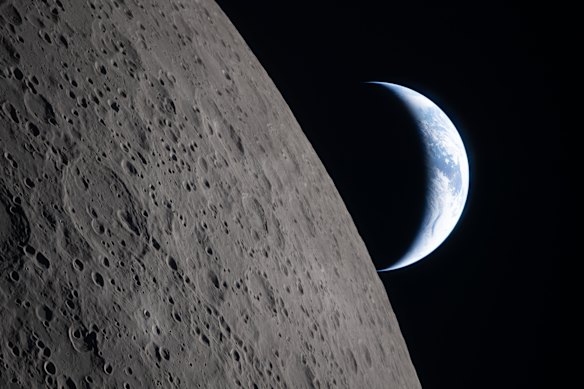
The Artemis II mission has captured never before seen images of the moon. NASA/AP
An hour later, the four astronauts on Artemis II – Reid Wiseman, Victor Glover and Christina Koch of NASA and Jeremy Hansen of the Canadian Space Agency – did something that is likely to become more common in the coming years: chatting with someone somewhere else in outer space.
In this case, they talked for about 12 minutes with colleagues aboard the International Space Station, which circles Earth about 400 kilometres above the surface.
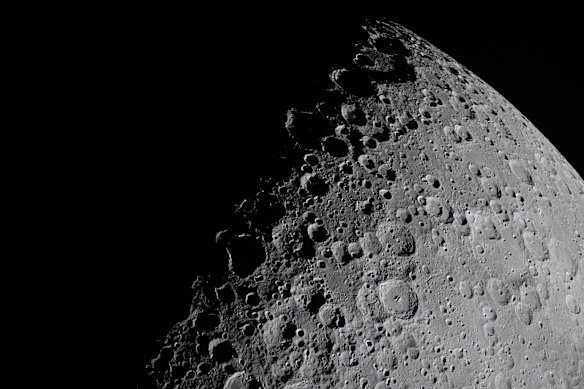
The Artemis II crew captured this image of a portion of the moon coming into view along the terminator, the boundary between lunar day and night, during the lunar fly-by. NASA/AP
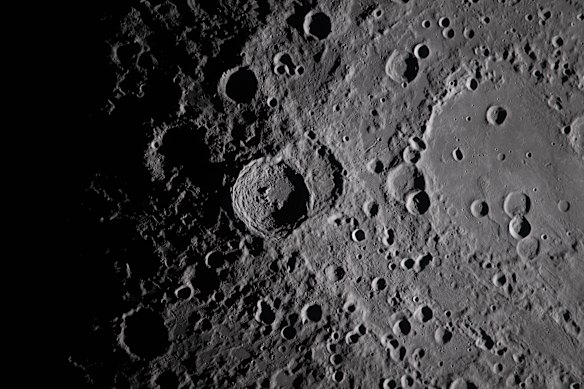
An image of the Vavilov Crater on the moon captured by the Artemis II. NASA/AP
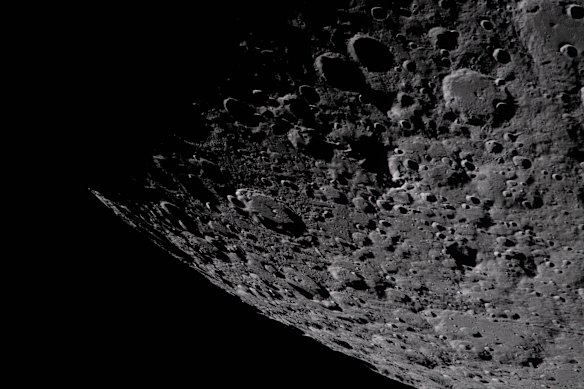
The Artemis II crew captured this image of the heavily cratered terrain of the eastern edge of the South Pole-Aitken basin of the moon. NASA/AP
Jessica Meir, one of the seven astronauts on the space station, asked the Artemis II astronauts about the different perspective of seeing the moon outside the window of Integrity instead of looking down at Earth looming below.
“I found myself noticing not only the beauty of the Earth,” Koch answered, “but how much blackness there was around it and how it just made it even more special.”
In 2019, Meir and Koch conducted the first all-woman spacewalk when they were both crew members on the space station. “Jessica, I always hoped we would be in space again together,” Koch said, “but I never thought it would be like this.”
The space station astronauts were not used to the 2.5-second gaps in conversation, the time it took for radio signals for their words to travel 370,000 kilometres to Artemis II and then for a response to arrive.
Sometimes they talked too soon, and their words collided with the Artemis II crew’s replies to earlier questions.
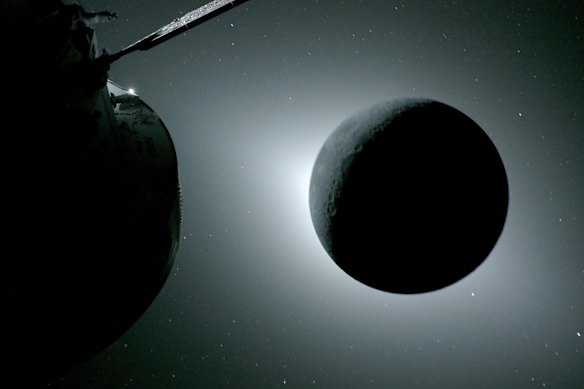
The moon, seen here backlit by the sun during a solar eclipse on April 6, 2026, as photographed by one of the cameras on the Orion spacecraft’s solar array wings.NASA
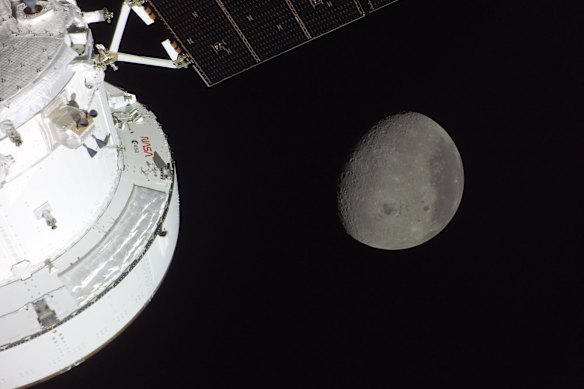
The Orion spacecraft in the foreground lit up by the sun. A waxing gibbous moon is visible in the background. Orientale basin, a 965-kilometre-wide impact crater ringed by mountains, is visible toward the centre bottom of the moon. NASA
Glover talked about the limited room within the Orion crew capsule, which has about as much space as two minivans. On the space station, an astronaut can usually move to another module for privacy. “So everything we do essentially starts with a spatial conflict,” Glover said.
Wiseman talked about zipping toward Earth, passing within 161 kilometres of the surface, before their spacecraft’s engine pushed them toward the moon. As Earth grew larger and larger outside the Orion window, “Jeremy turns around to us and goes, ‘I’m not sure – I think we’re going to run right into it,’” Wiseman said.
When the Artemis II crew set the record for the greatest distance from Earth ever, “We ran to the far end of the space station when you guys were on the other side, so that we could claim we were the furthest away from you in that moment,” Meir said.
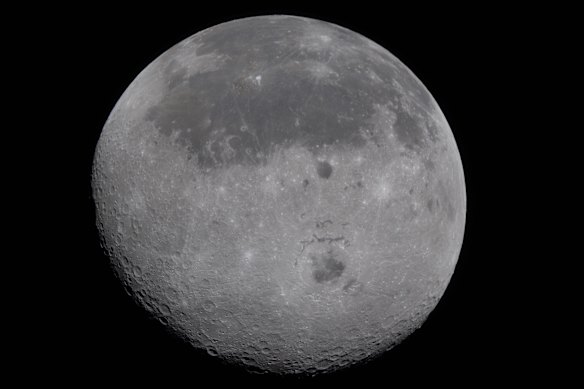
The near side of the moon (the hemisphere we see from Earth) visible at the top half of the disk, identifiable by the dark splotches. At the lower centre is Orientale basin. Everything below the crater is the far side.NASA/AP
Later in the afternoon, the Artemis II astronauts discussed their observations on Monday with Kelsey Young, the mission’s lunar science lead, who was at mission control in Houston. The first topic was several flashes seen on the night side of the moon that appeared to be meteors hitting the surface.
Young asked: How long were the flashes? Did they notice any colour in the flashes? And where on the moon did they occur?
Wiseman said the flashes were momentary, lasting half a second at most, and there was no noticeable colour.
The first batch of photos and data was sent back to Earth overnight, sped up by a new laser communication system.
“We got 20 gigabytes down in a little more than 45 minutes,” Rick Henfling, one of the mission’s flight directors, said during a news conference on Tuesday. That was much faster than the rate at which data is usually transmitted through space using longer wavelengths, he said.
Scientists on the ground have just begun analysing the reams of new information.
“I’ve spent most of my morning just flipping through, you know, the thousands of images that have started to come down,” Young said. “And there is something in every image that surprises me.”
This article originally appeared in The New York Times.
Get a note directly from our foreign correspondents on what’s making headlines around the world. Sign up for our weekly What in the World newsletter.