Cortex AI Analítica
"Análisis de relevancia para la actualidad."
- The announcement was made at a press conference in the city-state on Friday after Albanese toured Singaporean oil refineries vital to Australia’s fuel security.
Updated ,first published
Prime Minister Anthony Albanese has announced an agreement with Australia’s biggest petrol exporter, Singapore, to keep fuel and LNG flowing between the two nations as global oil shocks force companies to make hard choices on where tankers are directed.
The announcement was made at a press conference in the city-state on Friday after Albanese toured Singaporean oil refineries vital to Australia’s fuel security.
Prime Minister Anthony Albanese and Singaporean Prime Minister Lawrence Wong. Dominic Lorrimer
“We will keep trade flowing between our two countries. Essential goods will continue to move between Australia and Singapore,” Singaporean Prime Minister Lawrence Wong said.
“I have assured Prime Minister Albanese that Singapore will continue supplying refined fuels to Australia as a global refining hub. We will keep these flows going as long as upstream supplies continue.”
Australia gets more than half of its petrol from Singapore’s refineries. Singapore gets more than a third of its natural gas, which it uses for its electricity supply, from Australia.
Wong said his nation had no intention of restricting fuel exports throughout the crisis, but he stopped short of saying Australia would be prioritised should the war in the Middle East further constrict global oil supplies.
Work towards a legally binding protocol on economic resilience and essential supplies between the nations will also be accelerated.
How did we get here?
The US and Israel launched an assault on Iran on February 28, killing its supreme leader, Ayatollah Ali Khamenei. Iran retaliated by striking US military bases and embassies in neighbouring countries across the Gulf, and effectively closing the Strait of Hormuz, a narrow shipping corridor through which about 20 per cent of the world’s oil travels.
Iran’s stranglehold on the thoroughfare sent the price of oil soaring. The commodity hit almost $US120 a barrel at its peak.
Australian petrol prices soared to record highs last month as a result. Prices fell after a cut to the fuel excise, and the cost of unleaded petrol has continued to trend downwards to an average of about $2.24 per litre in Sydney and Melbourne. However, diesel has since climbed back up to record levels of about $3.25 per litre in the cities.
Under high demand for fuel driven by fears of shortages, more than 600 petrol stations ran out of at least one type of fuel last month, Energy Minister Chris Bowen reported. Fuel theft also spiked.
The government has assured Australians that shipments of oil have been arriving onshore as planned. Bowen this week said fuel supply was gradually returning to service stations, but 192 were still short on Friday.
Australia’s national reserves were 39 days of petrol, 29 days of diesel and 30 days of jet fuel, Bowen said in an update this week.
A tenuous ceasefire declared on Wednesday (AEST) immediately sent oil prices plunging to below $US91, raising hopes that fuel costs had peaked. Before the US-Israeli war on Iran, it was about $US70 a barrel.
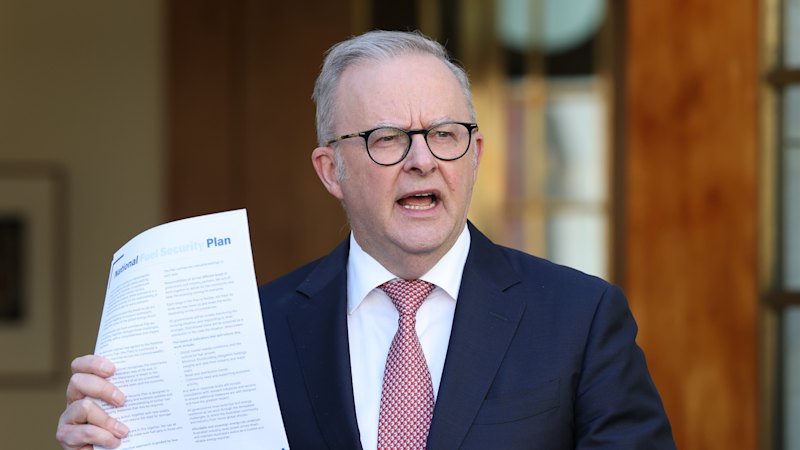
Prime Minister Anthony Albanese holds up a copy of the national fuel plan at Monday’s press conference.Alex Ellinghausen
But longer term consequences of the oil shock, which International Energy Agency chief Fatih Birol described last month as worse than the three biggest energy shocks in modern history combined, are expected to linger for months to come.
Albanese said on Thursday: “If the ceasefire holds, that doesn’t mean that the global capacity comes online in a week or a month. It will take a considerable period of time.”
Damage to oil and gas infrastructure in the Gulf would continue to affect production, and ships still had to start moving through the Strait of Hormuz again, the prime minister said.
“This will have a long tail, so what we are doing, and what we have done consistently here, is not to wait.”
What is the national fuel security plan?
The prime minister called an emergency national cabinet meeting last month, where all state and territory governments and the federal government agreed to a national fuel security plan. It sets out the national response to a global energy shock in four stages.
The first stage is called “plan and prepare”. Australia is already past this first level, in which fuel supply operates as normal. At this stage, the government works with fuel suppliers and distributors to gather supply chain information, such as by establishing a fuel supply co-ordinator in the first national cabinet meeting following the outbreak of the war in Iran.
Australia is in the second stage, “keeping Australia moving”, where there are localised disruptions to fuel supply. At this stage, the government will take precautionary measures to shore up fuel supply, such as negotiating with Australia’s Indo-Pacific neighbours to leverage the nation’s reputation as a reliable gas exporter in exchange for oil.
Motorists will also be urged to buy only the fuel they need, but they won’t be asked to reduce normal consumption.
Anthony Albanese announces the fuel excise cut on Monday, alongside ministers Chris Bowen and Jim Chalmers.Alex Ellinghausen
The third stage, “taking targeted action”, would include looking for ways to reduce Australians’ fuel consumption, including through voluntary changes such as working from home. The government would also consider releasing more of the country’s oil reserves, the plan says.
At the fourth level, “protecting critical services for all Australians”, the government would prioritise fuel for certain sectors and ensure the economy continued operating. In other words, it would ration fuel.
Bowen on Friday said supply into the country had remained stable and there was no need to trigger further steps.
”Should the international situation get worse, [the fuel security plan] makes clear prioritisation for emergency services,” he said. “But we are a long way from that. I’m pleased with the supply into Australia at this point.”
What measures have been taken?
The government made a suite of announcements alongside the fuel plan, and it has continued to provide regular updates on the number of service stations in each state that have run out of fuel.
Albanese halved the fuel excise, reducing petrol prices by 26¢ per litre for three months, at an estimated cost to the budget of $2.55 billion. A deal between the states to forgo GST revenue has cut another 6¢ from the excise.
The heavy vehicle road user charge, about 32¢ per litre, was also cut for three months, “to help truckies continue their vital work for our nation”, Albanese said.
The prime minister also made an address to the nation, urging Australians not to panic, and saying those who could take public transport to work should start doing so.
Emergency laws have been rushed through parliament to boost Australia’s fuel stocks, giving importers unprecedented government backing to scour the globe for petrol, diesel, crude oil and fertiliser. The scheme is designed to send a signal to importers to buy up whatever supply they can and bring it to Australia, without worrying about suffering a loss.
Earlier in the conflict, the government released about 20 per cent of Australia’s fuel reserves to boost domestic supply, including an agreement with fuel companies to direct this additional supply into country service stations, which have copped the brunt of shortages.
From our partners
Galería de Imágenes