Cortex AI Analítica
"Análisis de relevancia para la actualidad."
- Ian Tuason (left) wanted to create an all-consuming horror.

Filming a scary movie in his childhood home was unsettling enough for Ian Tuason, especially after having spent the past few years caring for his ailing parents in it. But when things began to genuinely go bump in the night, unease shifted to terror.
“As soon as the camera crew came in, the lights just started flickering,” says the Filipino-Canadian director, whose debut feature Undertone hits theatres on Thursday. “I was telling them that weird things had started happening as I prepared to make the movie. Eventually, they were like, ‘Ian, I think we’re starting to believe you’.”
Ian Tuason (left) wanted to create an all-consuming horror. What better way to do that than with sound?A24
In a particularly unexplainable instance, one of the actors dreamt the exact details of one of the film’s scenes ... before she had read the script. “If you ask any crew member, they’re going to tell you they didn’t really believe in the paranormal before. Now, they do,” Tuason says.
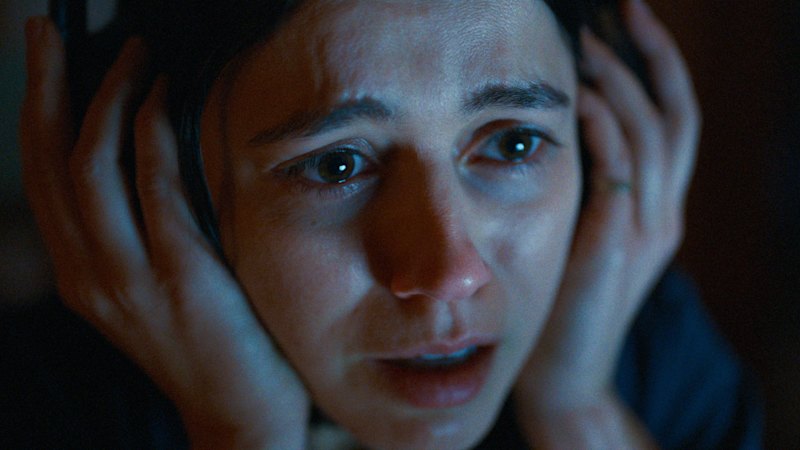
When such horror takes place in your own home, it can feel impossible to escape. This is what largely drives Underscore, an A24 horror that follows podcaster Evy (Nina Kiri, The Handmaid’s Tale) who, while caring for her dying mother, discovers a series of mysterious audio files that send her into a reality-bending nightmare.
Nina Kiri descends into a reality-bending psychosis in Undertone, largely thanks to the terrifying sounds around her.A24
Tuason was determined to convey a uniquely all-consuming fear to audiences. He knew sequences of scary shots weren’t enough – he needed to envelop viewers with fear. There was only one thing that could accomplish that: sound.
“I would say that sound in horror movies is about 70 to 80 per cent of the fear-factor,” Tuason says. “Since Undertone relies heavily on sound, there’s really no escape. Especially because I also use silence as a scare … You feel a lot safer if you plug your ears when watching horror, as opposed to covering your eyes.”
Sound drives much of our fear response, whether we notice it or not. Consider the dread evoked when the piano motif strikes up in Halloween, or the disorienting nature of the distorted whispers in The Shining. More often than not, you need sound to pull off a visual jump scare, be it a loud bang or scream. Sound, on the other hand, can petrify on its own.
Ian Tuason (right) filmed Undertone in his own childhood home. What’s scarier than that?A24
Sound is thus vital in any horror, but Undertone amplifies its effect by 100. Originally conceived as an immersive 250-page audio-cue script (more than double the length of a standard screenplay), the film consists of two distinct audio worlds: the podcast realm and Evy’s home environment.
“There was more sound direction in my script than camera direction,” Tuason says. “The recordings that Evy listens to were recorded with an iPhone – the lo-fi sound has a certain texture. I wanted the audio there to sound like found-audio, like from found-footage. Then, between her recording sessions, I went into the Dolby Atmos world where you’re entering a 3D soundscape. In the end, they blend together, so you’re not sure which world you’re in.”
The film’s script tested people’s patience, Tuason says. It was filled with directional audio cues, such as the exact direction he wanted the sound of a baby’s cry to come from in a surround-sound environment. Though such directional audio isn’t altogether new, Tuason says he applied it in a way few filmmakers have before, aided by his background in virtual reality.
“I was always thinking about 360-degree soundscapes,” he says.
Of course, this comes with certain limits. Not everyone will watch Undertone on the big screen or with surround-sound, especially as rates of smartphone and tablet viewing increase. This doesn’t bother Tuason, though, who says the film was carefully tested in various environments. It’s still scary to watch, though he admits that smartphone audiences won’t enjoy the full, spine-tingling experience.
Granted, Tuason is aware that horrors such as Underscore, which are more experimental in nature, won’t satisfy everyone. Its predecessors – films such as The Blair Witch Project and Paranormal Activity, the reboot of which Tuason was recently tapped to helm – were incredibly polarising for their “slow burn” nature.
“There are two types of horror films: The ones that show visual scares and the ones that imply what’s happening through what you hear off-screen, word-of-mouth or the telling of ghost stories,” he says.
“There are those who don’t find it scary because they don’t see anything, and then there are those who are terrified. I’ve noticed people who have a rich imagination tend to be the ones who are the most scared of Undertone. So, if you are scared, then kudos. You probably imagined some really messed up things that I could never show you.”
Undertone will screen in cinemas from April 9.
Must-see movies, interviews and all the latest from the world of film delivered to your inbox. Sign up for our Screening Room newsletter.

From our partners
Galería de Imágenes