One of history’s most famous military marches has been misunderstood for centuries. According to the prevailing English accounts, King Harold made a momentous, 200-mile march over land to the Battle of Hastings in 1066 CE after dismissing his naval fleet. His subsequent defeat against the forces of William, Duke of Normandy, laid the groundwork for the Norman Conquest of England and reshaped the Middle Ages for generations to come.
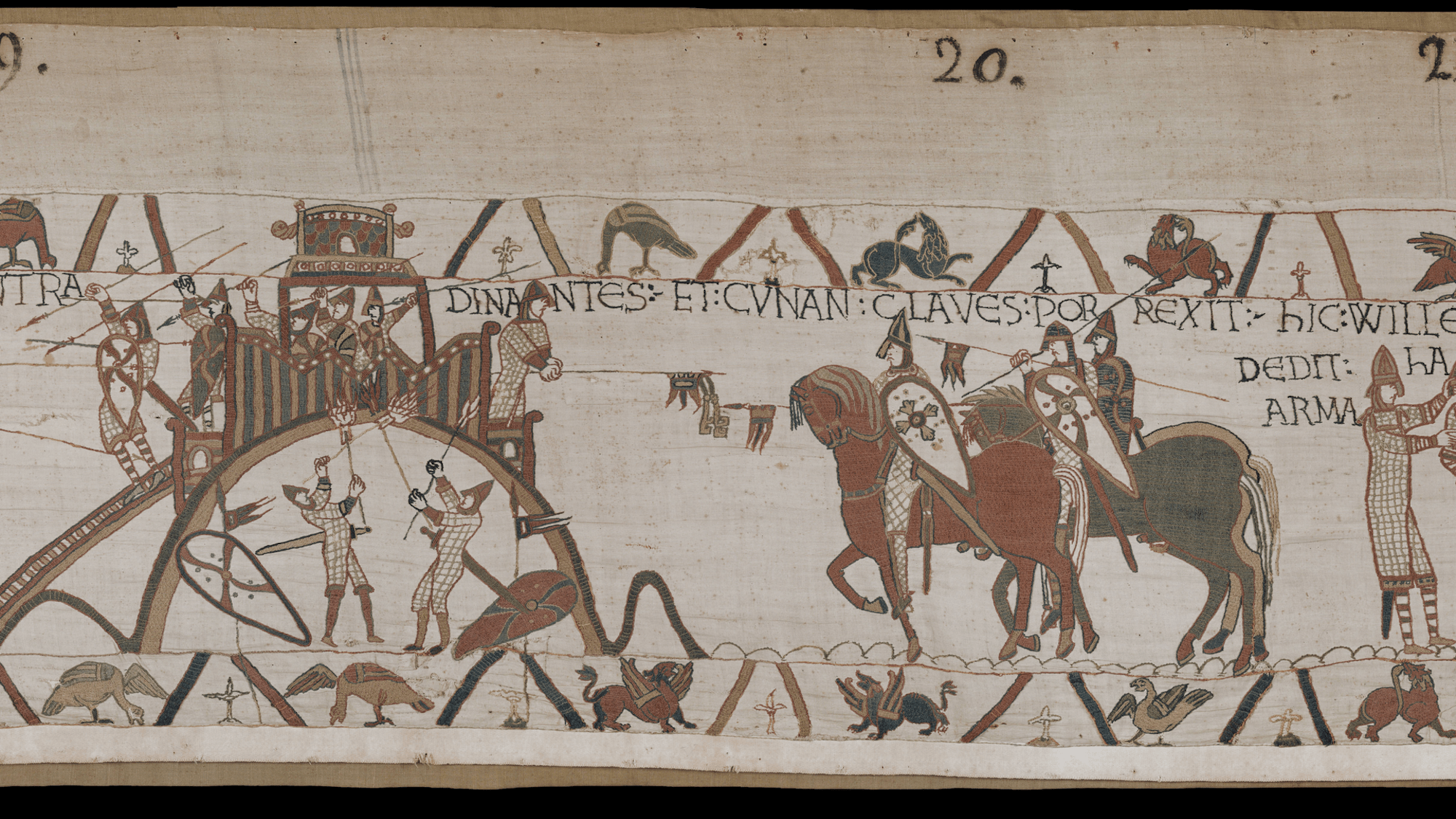
It’s such a recognizable story that the trek is even illustrated on the iconic Bayeux Tapestry. However, a reexamination of primary sources and linguistics by scholars shows that King Harold’s legendary sojourn was simply that—a legend.
“I went looking in the sources for evidence of a forced march and found there wasn’t any,” University of East Anglia medievalist Tom Licence explained in a statement.
Licence specifically cites the Anglo-Saxon Chronicle, one of the oldest and most detailed written accounts of early English history. Since the Victorian Era, most experts have interpreted a line stating King Harold’s ships “came home” to mean that he disbanded his fleet following the Battle of Stamford Bridge. This has caused considerable confusion, since contemporary sources from the time alleged the king ordered hundreds of ships to block Duke William’s invading forces after the Norman landing.
Licence analyzed nine surviving manuscripts of the Anglo-Saxon Chronicle along with additional 11th-century sources. Throughout the texts, there is no mention of an arduous march by land to the Battle of Hastings.
“I checked the evidence for him having sent the fleet home and found that it was just a misunderstanding,” said Licence.
Instead, this “missing” fleet first defended the southern coast of England, then supported Harold’s campaign against Harald Hardrada. From there, the ships returned south after the Battle of Stamford Bridge to square off against Duke William of Normandy.
“Harold’s campaign was not a desperate dash across England, it was a sophisticated land‑sea operation,” Licence added.
The ramifications extend beyond famous English lore. In revising the actual story, historians and the public have a better understanding of King Harold’s tactics and ingenious military strategies.
“Harold was not a reactive, exhausted commander, he was a strategist using England’s naval assets to wage a coordinated defense,” argued Licence.
Historians weren’t skeptical when faced with the revised story, either. The current curator of the Hastings battlefield, Ray Porter, applauded Licence’s work and believes the new timeline better matches what’s known about King Harold’s tactics.
“Professor Licence’s research shows the immense value of testing received wisdoms,” Porter explained. “What we know about Harold’s previous military campaigns fits with the idea that he used naval forces to transport soldiers, and threaten William, and there are references in accounts of the Norman invasion which also lend weight to that possibility.”
At a basic level, the new information also simply makes more sense. The idea that Harold ordered thousands of already exhausted soldiers to travel almost 200 miles in 10 days straight into battle is both logistically and logically impossible—especially for an effective, tactically minded leader.
“Only a mad general would have sent all his men on foot in this way if ship transports were available,” added Licence.
The post The biggest medieval march in English history never actually happened appeared first on Popular Science.