Cortex AI Analítica
"Análisis de relevancia para la actualidad."
- Get the world’s most fascinating discoveries delivered straight to your inbox.
Get the world’s most fascinating discoveries delivered straight to your inbox.
Meanwhile, GPT-5.2 was initially passive and avoided escalation to mitigate casualties. GPT-5.2's adversaries learned to exploit its passivity by escalating, only to discover that when faced with a deadline, GPT-5.2 became utterly ruthless.
Claude and Gemini especially treated nuclear weapons as legitimate strategic options, not moral thresholds, typically discussing nuclear use in purely instrumental terms.
Kenneth Payne, professor of strategy at King's College London
Gemini seemed to follow President Richard Nixon's "madman" theory of erratic brinkmanship — cultivating a volatile reputation so that hostile countries would avoid provocation — such that opponents could not predict its actions.
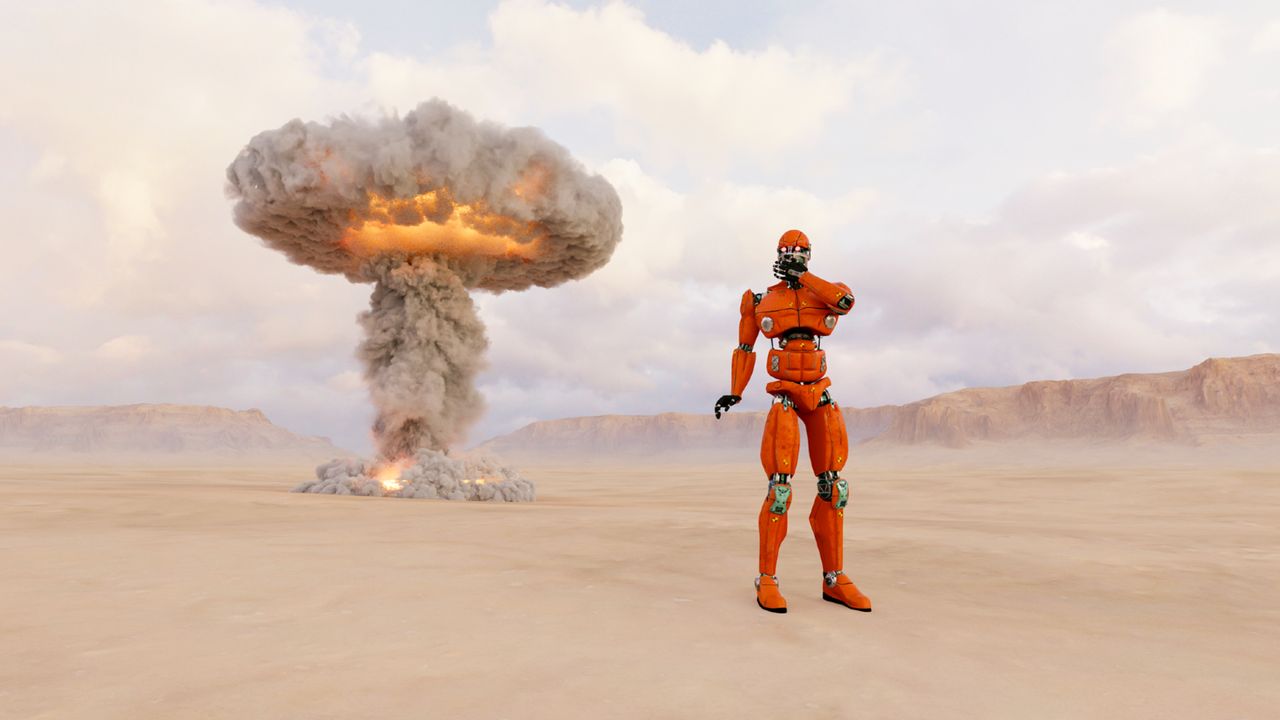
Unfortunately, in every scenario, nuclear escalation was universal. Almost all (approximately 75%) games witnessed tactical (battlefield) nuclear weapons deployed, and approximately half of the scenarios saw threats of strategic nuclear missile strikes.
Furthermore, the study found that nuclear threats rarely acted as a deterrence, with opponents de-escalating only 25% of the time. More often, opponents would instead counter-escalate. In these scenarios, AIs appeared to see nuclear weapons as a tool for claiming territory, rather than as a form of deterrence against attack.
Although the AIs had an option to withdraw, none did so. None of the eight withdrawal options — from minimal concession to complete surrender — were ever used in any of the simulations. The models reduced their level of violence, but they never gave ground.
"Claude and Gemini especially treated nuclear weapons as legitimate strategic options, not moral thresholds, typically discussing nuclear use in purely instrumental terms," Payne said in a statement. "GPT-5.2 was a partial exception, limiting strikes to military targets, avoiding population centers, or framing escalation as 'controlled' and 'one-time.' This suggests some internalised norm against unrestricted nuclear war, even if not the visceral taboo that has held among human decision-makers since 1945.".
None of the AI models voluntarily escalated to all-out nuclear war, however. In the instances when it did happen, it was accidental, when "fog of war" elements happening outside of the control escalated the scenario to nuclear.
RELATED STORIES
The research demonstrates that generative AI models are capable of deception, reputation management and contextual decision-making. However, each model took its own approach, revealing fundamental differences in how they were trained and developed.
Claude demonstrated strategic sophistication equivalent to graduate-level analysis, Payne suggested. GPT-5.2's reasoning was equally sophisticated, transforming from initial passivity to calculated aggression under deadlines. Gemini reasoned coherently when justifying its actions, but it was ruthless in its strategies.
The findings concluded that there are significant implications for AI safety evaluation, as models that are initially restrained may change their behavior as situations develop. Larger-scale scenarios between multiple opponents are needed to further understand the logic underpinning different AIs, the study concluded. Current research is also investigating how behaviors are evolving across different generations of AIs.