Cortex AI Analítica
"Análisis de relevancia para la actualidad."
- Breaking space news, the latest updates on rocket launches, skywatching events and more!
Breaking space news, the latest updates on rocket launches, skywatching events and more!
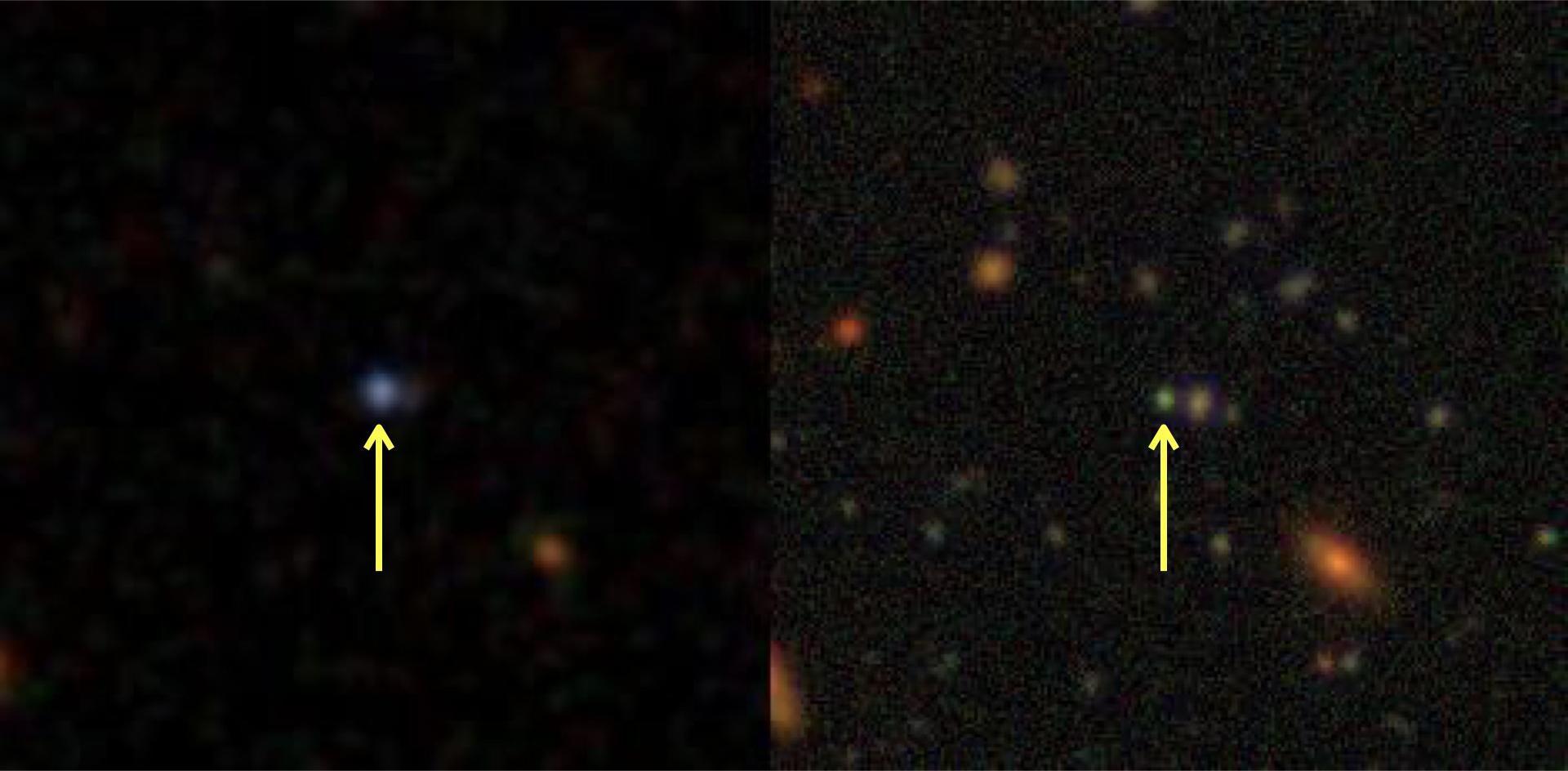
Visible-light images of the galaxy J0218−0036 (redshift 1.8; about 10 billion light-years away), indicated by the yellow arrows. The image on the left was taken by the Sloan Digital Sky Survey (SDSS), and the image on the right by Hyper Suprime-Cam (HSC) on the Subaru Telescope. Because HSC has higher sensitivity than SDSS, many additional faint objects are visible in the HSC image. Comparing the brightnesses in the two images shows that the galaxy faded dramatically between about 2002 (SDSS) and 2018 (HSC). (Image credit: SDSS, HSC-SSP/NAOJ)
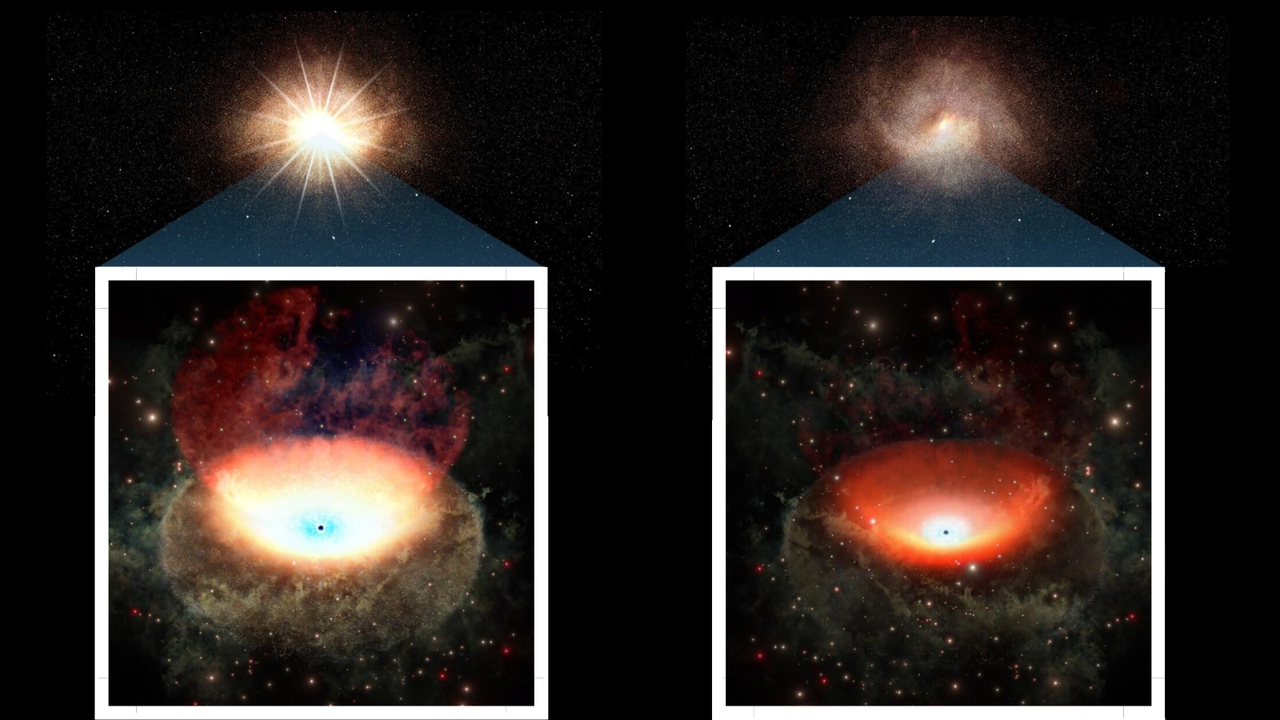
Following this investigation, the team determined the rate at which gas was flowing from the accretion disk to this supermassive black hole had been cut by around 98% over the course of just seven years. That told the researchers the supply of matter to the accretion disk was rapidly decreasing.
The researchers confirmed this was a case of the food supply of this black hole being staunched, by ruling out the possibility that a cloud of gas had passed in front of the accretion disk, temporarily blocking its light. They determined that such blocking couldn't account for changes across all the different wavelengths of light they studied.
Though the cut in gas supply to this AGN and the end of replenishment of the accretion disk that is gradually feeding this supermassive black hole are certain, what the team can't be completely sure of is what is causing this cessation. Even with that mechanism shrouded in mystery, this research shows that changes in the mass accretion of supermassive black holes don't always take thousands of years, as previously thought.
"This object shows rapid variability that cannot be explained by standard models. It provides an important test case for developing new theoretical models," team member Toshihiro Kawaguchi of the University of Toyama said. "We will investigate what physical conditions could reproduce the observed behavior."
The team's research was published in the journal Publications of the Astronomical Society of Japan (PASJ).